1.25x Rental Portfolio Coverage: Does Rent Support Your Debt Obligations?
A rental portfolio may report substantial gross rent without producing enough eligible cash flow to meet its debt obligations. The useful question is not…
Imovitec · September 07, 2026
A rental portfolio may report substantial gross rent without producing enough eligible cash flow to meet its debt obligations. The useful question is not merely how much rent was billed. It is how much eligible cash flow, under a documented definition, covers debt service for the same period.
Definition: A 1.25x coverage ratio means R$1.25 of defined eligible cash flow for each R$1.00 of defined debt service in the same period.
The ratio is an analytical threshold. It is not a universal market standard, a return measure, or a payment guarantee. Its interpretation depends on the relevant financial instrument or internal policy.
Key takeaways
Portfolio coverage divides eligible cash flow by debt service for the same period. At 1.25x, the calculated excess equals 25% of debt service, not 25% safety or return. Gross rent requires reconciliation, missing required inputs make the ratio not calculable, and no approved primary source establishes 1.25x as a universal rental-market rule.
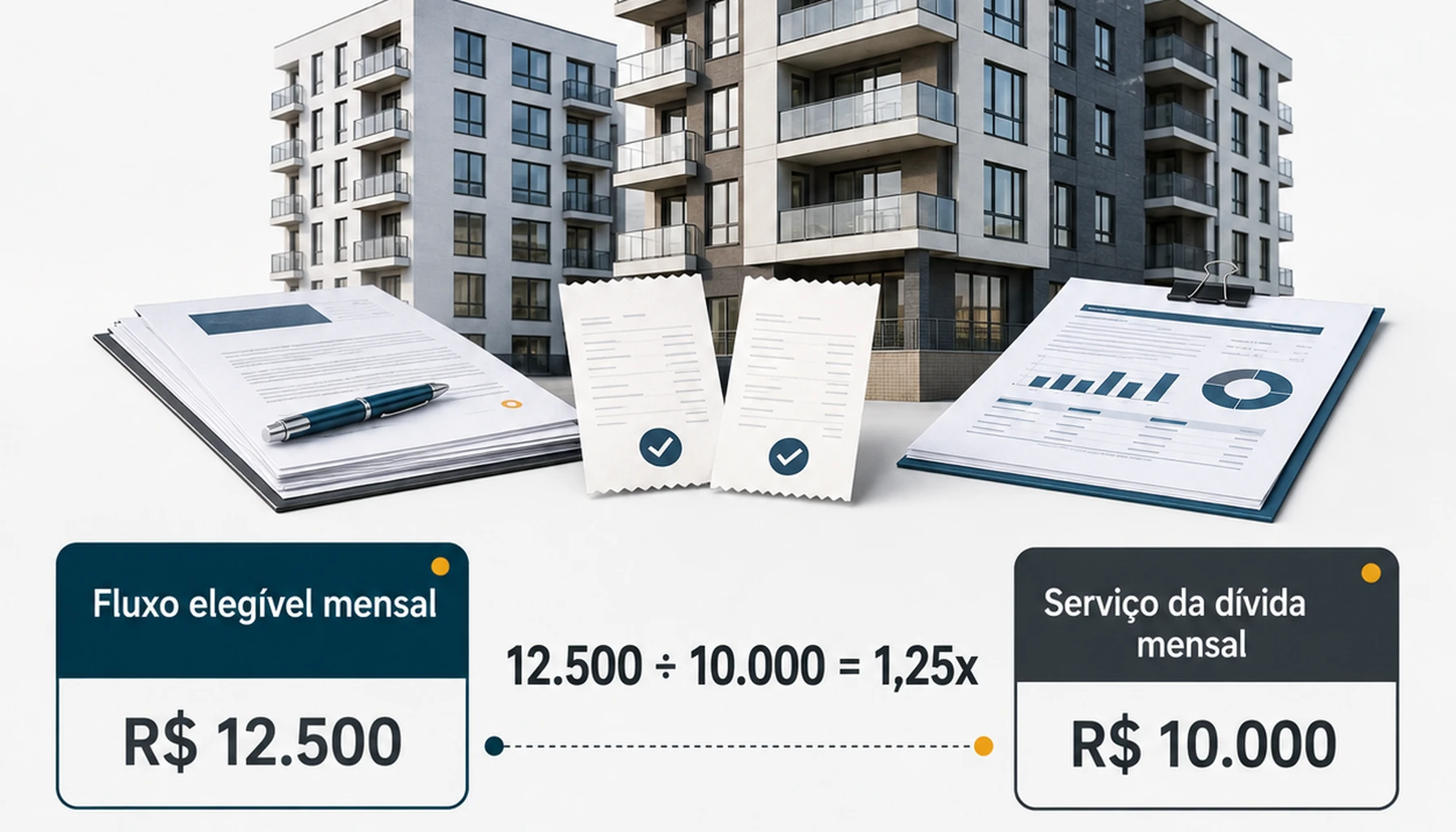
- In a hypothetical monthly example, R$12,500 divided by R$10,000 equals 1.25x.
- If debt service stays constant, a 20% reduction in the initial eligible cash flow takes 1.25x to 1.00x.
- That static calculation does not establish a 20% tolerance for vacancy.
- Legal responsibility for a property charge does not automatically determine its treatment in the ratio.
- Covenant definitions, periods, rounding rules, and missing-data policies must remain explicit.
What does a 1.25x portfolio coverage ratio mean?
A 1.25x ratio means that defined eligible cash flow is 1.25 times defined debt service for a matching period. The contract, indenture, prospectus, or documented internal policy must determine the numerator, denominator, accounting basis, testing window, rounding treatment, and consequences attached to the result.
The calculation is simple: divide eligible cash flow for the period by debt service for that same period. The answer is expressed in times, or “x.” Classification choices beneath that division can materially change the result.
Public documents filed through Brazil’s Comissão de Valores Mobiliários (CVM) show contextual uses of the Debt Service Coverage Ratio, also known as DSCR or ICSD. An indexed quarterly filing for the period ended March 31, 2021, contains a covenant of at least 1.25x for specific issuances. The recovered record does not securely establish the issuer, page, complete formula, test frequency, or consequences of breach.
A separate document disclosed through the CVM’s RAD system reproduces a rating analysis that mentions projected DSCR above 1.25x in 2026 for UTE Pampa. That example concerns an electric-power project, not rental property. Both records show contextual use, not a general real-estate rule.
Before treating 1.25x as a target, classify it correctly: contractual covenant, internal analytical threshold, or scenario assumption.
How is rental portfolio coverage calculated?
Divide reconciled eligible cash flow by debt service for the identical month, quarter, year, or rolling window. Retain the definition, basis, currency, precision, and missing-data rule required by the governing document. Calculate with full available precision and display two decimal places unless that document prescribes another method.
Hypothetical monthly example
| Component | Hypothetical monthly amount |
|---|---|
| Eligible cash flow | R$12,500 |
| Debt service | R$10,000 |
| Coverage | 1.25x |
R$12,500 divided by R$10,000 equals 1.25x. These are illustrative amounts, not market data.
The 0.25x excess equals 25% of debt service: divide 1.25 by 1.00, then subtract 1. Debt service is the denominator. Describing this result as a “25% safety margin” would claim more than the arithmetic proves.
Rounding also matters. A raw result of 1.245 must not be declared compliant with a 1.25x covenant unless its governing document expressly permits that rounding treatment.
What belongs in eligible cash flow?
No approved source supplies a universal list. Eligible cash flow may begin with collected rent, but the treatment of administration, maintenance, taxes, insurance, condominium charges, provisions, delinquency, and recoverable expenses must follow the applicable definition and a documented accounting or management policy.
Gross billed rent, collected rent, accounting revenue, net operating income, and cash flow available for debt service are not interchangeable labels. Any movement from one measure to another needs an explicit reconciliation.

What belongs in debt service?
Interest and principal amortization may be included. Other installments belong in the denominator only when the contractual definition requires them.
Confirm payment dates, grace periods, balloon payments, indexation, cure provisions, and whether the test uses a single date or rolling window. This discipline resembles the evidence checks in a real estate feasibility study: a conclusion is only as defensible as its definitions and assumptions.
Can gross rent be used directly in the ratio?
No, not without reconciliation. Gross billed rent, collected rent, accounting revenue, and eligible cash flow may differ in amount and timing. The approved evidence establishes no universal bridge from gross rent to DSCR for rental portfolios, so each adjustment must follow the applicable instrument and documented policy.
A practical reconciliation should identify:
- Rent billed during the test period.
- Amounts collected when the policy uses a cash basis.
- Adjustments permitted by the contract or methodology.
- Expenses and provisions deducted under the selected definition.
- Recoverable charges and their treatment.
- Eligible cash flow tied to supporting records.
The Banco Central do Brasil defines delinquency generally as failure to pay by the agreed due date in its Simplified Glossary of Financial Terms. That source does not define rental delinquency, loss provisions, or DSCR treatment. A portfolio therefore needs a documented rule aligned with its debt instrument and reviewed by the appropriate specialists.
Who is responsible for rent and property charges in Brazil?
Brazil’s Urban Tenancy Law assigns legal and contractual responsibilities for rent and several property charges. Those assignments do not determine automatically how an item enters a coverage ratio. Legal responsibility and financial classification require separate mappings, based on the law, the lease, and the relevant debt instrument.
Article 23(I) of Law No. 8,245 of October 18, 1991 states that the tenant must pay rent and legally or contractually enforceable charges punctually. Articles 22 and 25 address obligations involving taxes, charges, condominium expenses, and complementary fire insurance. Treatment depends on the expense, contractual wording, and statutory limits.
This account relies on the consolidated text published by the Presidency of the Republic, Civil House, accessed September 7, 2026. The research package did not verify the latest amendment date. Legal review should confirm the current text and relevant clauses. The law governs urban leases, not DSCR methodology.
Create two maps. One assigns legal or contractual responsibility; the other classifies cash-flow treatment. Combining them without analysis can overstate or understate coverage.
Articles 22 and 25 address obligations involving taxes, charges, condominium expenses, and complementary fire insurance.
Talk to a specialist
Want to see this applied to your case?
Instead of finishing the article and staying in theory, send us your situation on WhatsApp. We reply with the concrete next step.
Does 1.25x absorb a 20% fall in cash flow?
Only in a static scenario. If eligible cash flow begins at 1.25 times debt service, debt service remains unchanged, and only the numerator falls uniformly, a 20% reduction takes coverage to 1.00x. The calculation concerns initial eligible cash flow and does not establish a universal vacancy tolerance.
The reduction is calculated as 1 minus 1.00 divided by 1.25, which equals 20% of initial eligible cash flow. Costs, interest, amortization, taxes, and collection timing are assumed not to change.
At 1.00x, eligible cash flow merely equals debt service under the selected definitions. There is no calculated excess for that period. Below 1.00x, eligible cash flow is lower than debt service, but the consequence still depends on liquidity, reserves, guarantees, cure rights, and contractual terms.
How should a market-intelligence team monitor coverage?
A market-intelligence team should calculate coverage monthly or quarterly, connect it to annual budgeting and scenarios, and follow the period required by the instrument or internal policy. The control record should expose both components, document every material classification, and treat missing required data as “not calculable,” never as zero.

Seven-step control routine
- Lock the definition: Record the authorized numerator, denominator, basis, test period, rounding rule, and covenant conditions.
- Reconcile eligible cash flow: Tie material components to leases, receipts, bank records, ledgers, and approved adjustments.
- Reconcile debt service: Match the denominator to lender schedules and payment obligations for the same period.
- Classify charges separately: Keep legal responsibility distinct from ratio treatment.
- Flag missing data: Report “not calculable” when a required value is unavailable.
- Run controlled scenarios: Name each changed assumption and disclose what remains constant.
- Escalate exceptions: Refer ambiguous items for financial, legal, accounting, tax, or property review.
A dashboard should display the ratio and its components. A single colored indicator can conceal whether deterioration came from collections, expenses, interest, amortization, or data quality. Similar scrutiny should guide the selection of market-intelligence solutions.
Teams maintaining a broader indicator routine may also review which real estate market data to track weekly. Current figures for Selic, inflation, vacancy, and delinquency are intentionally excluded because the approved evidence did not establish sufficiently verified publication dates, reference periods, and methodologies.
What should the decision record say?
The decision record should classify coverage as above, at, below, or unable to calculate against the selected threshold. It should then state the governing definition, test period, reconciled evidence, assumptions, missing information, review status, and operational or contractual consequence without presenting the ratio as a promise.
A defensible statement is:
For the stated period, coverage calculated under Policy X is 1.25x, based on reconciled eligible cash flow and debt service for the same interval. This is an internal analytical threshold, not a universal market standard. The result remains subject to the adjustments and reviews listed in the record.
The number becomes useful when a repeatable process makes definitions, data quality, uncertainty, and exposure visible.
Sources
- Presidency of the Republic, Civil House, Law No. 8,245 of October 18, 1991, especially Articles 22, 23, and 25, accessed September 7, 2026: https://www.planalto.gov.br/ccivil_03/leis/l8245.htm. Consolidated text; latest amendment date not verified in the supplied research.
- Comissão de Valores Mobiliários, RAD system, ITR, Quarterly Information, March 31, 2021, accessed September 7, 2026: https://www.rad.cvm.gov.br/ENET/frmDownloadDocumento.aspx?Tela=ext&numProtocolo=1242867&descTipo=IPE&CodigoInstituicao=1. The indexed excerpt indicates a covenant of at least 1.25x; issuer, page, formula, frequency, and breach consequences require confirmation.
- Comissão de Valores Mobiliários, RAD system, disclosed document reproducing Rating da UTE Pampa rebaixado para 'brAA+' diante de..., accessed September 7, 2026: https://www.rad.cvm.gov.br/ENET/frmDownloadDocumento.aspx?Tela=ext&numSequencia=962666&numVersao=1&numProtocolo=1437954&descTipo=IPE&CodigoInstituicao=1. Electric-power project, not rental property; title, author, date, pages, formula, and assumptions require confirmation.
- Banco Central do Brasil, Simplified Glossary of Financial Terms, publication date not confirmed, accessed September 7, 2026: https://www.bcb.gov.br/content/cidadaniafinanceira/documentos_cidadania/Informacoes_gerais/glossario_cidadania_financeira.pdf. Supports only the general meaning of delinquency.
FAQ
How many months of rent does rental guarantee insurance cover, and does that improve portfolio coverage?
Rental guarantee insurance covers only the period and events specified in its policy. It may reduce collection risk, but it does not automatically increase 1.25x portfolio coverage. Analysts should include insurance proceeds only when the adopted contract or documented policy treats them as eligible cash flow for the same measurement period.
How should rental taxes be treated when calculating debt service coverage?
Rental taxes should follow the applicable legal, accounting, and contractual treatment, not a universal deduction rule. The current Brazilian tax schedule must be verified from an official source for the relevant taxpayer and period. Analysts should document whether each tax affects eligible cash flow and avoid counting the same expense twice.
What's the best way to account for rental guarantees in a 1.25x coverage analysis?
The best approach is to model each rental guarantee according to its contractually recoverable amount, timing, exclusions, and collection conditions. A deposit, guarantor, or insurance policy is not equivalent to collected rent. Include recoveries in eligible cash flow only when the governing coverage definition permits them and the period is consistent.
What is a 1.25x rental portfolio coverage ratio, and how does it work?
A 1.25x coverage ratio means R$1.25 of defined eligible cash flow for every R$1.00 of defined debt service in the same period. The calculation is eligible cash flow divided by debt service. It is an analytical threshold or contractual covenant when expressly adopted, not a universal real estate market standard.
Should I use gross rent or net cash flow to calculate portfolio coverage?
Use the cash flow definition established by the relevant debt instrument or documented internal policy. Gross rent cannot be treated automatically as cash available for debt service. Reconcile billed and collected rent with permitted adjustments, expenses, recoveries, and missing data, while keeping the numerator and denominator within the same period.
Is maintaining 1.25x coverage worth the cost of reserves or operational changes?
The value of targeting 1.25x depends on the financing terms, risk appetite, and cost of corrective measures. At 1.25x, the arithmetic excess equals 25% of debt service, but it is not a 25% return or safety guarantee. Compare scenarios for reserves, exposure, expenses, and debt before deciding.
Can the same 1.25x methodology be applied to every rental portfolio?
No, a single 1.25x methodology is not automatically applicable to every rental portfolio. Definitions of eligible cash flow, debt service, accounting basis, testing window, and missing data may differ. Analysts should follow the governing instrument or internal policy and obtain financial, legal, accounting, and real estate validation when applicable.
Talk to a specialist
Have a real case to solve?
Message Imovitec on WhatsApp. We reply fast and already speak your context — no forms, no waiting.
Frequently asked questions
How many months of rent does rental guarantee insurance cover, and does that improve portfolio coverage?
Rental guarantee insurance covers only the period and events specified in its policy. It may reduce collection risk, but it does not automatically increase 1.25x portfolio coverage. Analysts should include insurance proceeds only when the adopted contract or documented policy treats them as eligible cash flow for the same measurement period.
How should rental taxes be treated when calculating debt service coverage?
Rental taxes should follow the applicable legal, accounting, and contractual treatment, not a universal deduction rule. The current Brazilian tax schedule must be verified from an official source for the relevant taxpayer and period. Analysts should document whether each tax affects eligible cash flow and avoid counting the same expense twice.
What's the best way to account for rental guarantees in a 1.25x coverage analysis?
The best approach is to model each rental guarantee according to its contractually recoverable amount, timing, exclusions, and collection conditions. A deposit, guarantor, or insurance policy is not equivalent to collected rent. Include recoveries in eligible cash flow only when the governing coverage definition permits them and the period is consistent.
What is a 1.25x rental portfolio coverage ratio, and how does it work?
A 1.25x coverage ratio means R$1.25 of defined eligible cash flow for every R$1.00 of defined debt service in the same period. The calculation is eligible cash flow divided by debt service. It is an analytical threshold or contractual covenant when expressly adopted, not a universal real estate market standard.
Should I use gross rent or net cash flow to calculate portfolio coverage?
Use the cash flow definition established by the relevant debt instrument or documented internal policy. Gross rent cannot be treated automatically as cash available for debt service. Reconcile billed and collected rent with permitted adjustments, expenses, recoveries, and missing data, while keeping the numerator and denominator within the same period.
Is maintaining 1.25x coverage worth the cost of reserves or operational changes?
The value of targeting 1.25x depends on the financing terms, risk appetite, and cost of corrective measures. At 1.25x, the arithmetic excess equals 25% of debt service, but it is not a 25% return or safety guarantee. Compare scenarios for reserves, exposure, expenses, and debt before deciding.
Can the same 1.25x methodology be applied to every rental portfolio?
No, a single 1.25x methodology is not automatically applicable to every rental portfolio. Definitions of eligible cash flow, debt service, accounting basis, testing window, and missing data may differ. Analysts should follow the governing instrument or internal policy and obtain financial, legal, accounting, and real estate validation when applicable.
Imovitec
Turn data into next steps.
Take the Imovitec diagnostic and see where your best opportunities are.