Occupied Property at Auction: How Time to Possession Changes the Maximum Bid
An occupied auction property should not receive an arbitrary percentage discount. Its maximum bid should reflect the cash flows and risks between payment and…
Imovitec · October 09, 2026
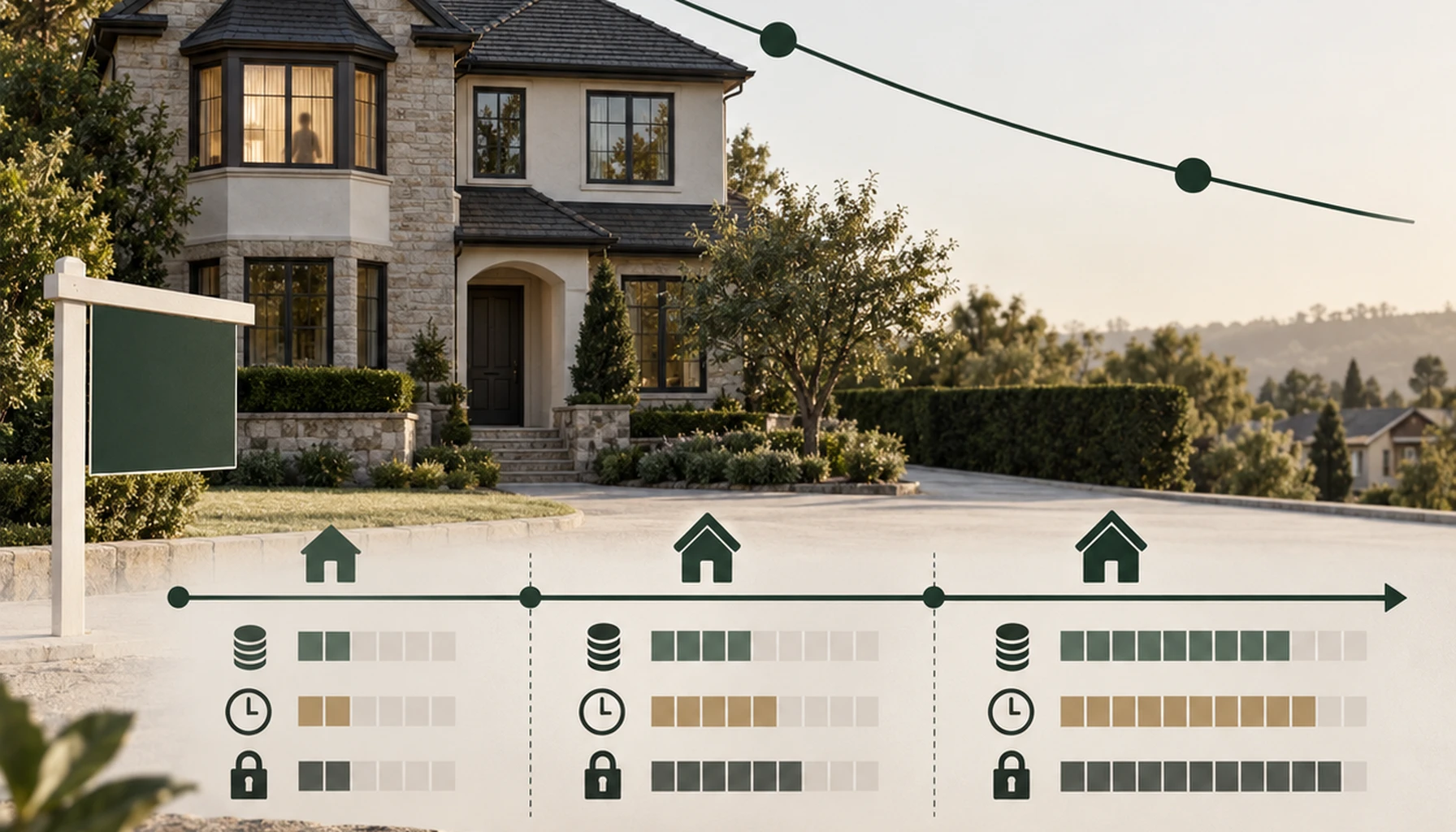
An occupied auction property should not receive an arbitrary percentage discount. Its maximum bid should reflect the cash flows and risks between payment and effective possession: documented carrying costs, delayed net income, possession expenses, contingencies and the buyer’s cost of capital.
This distinction matters when brokers and opportunity analysts advise clients in Brazil. A visible discount against an appraisal may look attractive, but the economic result depends on when the buyer can possess, regularize and use or rent the property. The approved sources provide no reliable national average for that interval.
Key takeaways
Occupancy changes the timing, cost and risk of an acquisition. It should therefore be modeled through documented cash flows and separate possession scenarios. Neither a nominal auction discount nor a statutory occupancy charge proves that the transaction will produce an adequate return.
- Occupancy belongs in a cash-flow model, not a generic discount table.
- Article 30 of Law 9,514/1997 provides a specific possession remedy with a 60-day vacating period. It does not guarantee effective possession within 60 days of the auction.
- Judicial auctions and extrajudicial fiduciary-foreclosure auctions follow distinct legal regimes.
- The statutory occupancy charge is not guaranteed income or an automatic offset against lost rent.
- Without defensible probabilities, short, intermediate and long scenarios should remain separate.
- Legal and financial review should precede any recommendation or maximum bid.
How should occupancy affect the maximum bid?
Occupancy should reduce the maximum bid by the present value of costs and net income deferred until possession, plus case-specific contingencies and a safety margin. The calculation should start with the documented value of the property when vacant and regularized, not the nominal discount shown in the auction listing.
Maximum bid = vacant and regularized value − immediate costs − present value of monthly costs − present value of lost net income − present value of possession costs − contingency − safety margin.
This equation is a financial inference, not a statutory valuation formula. Every input depends on the property, the documents, the intended use and the investor. An unsupported item must remain unknown or appear as an explicit range. It must not silently become zero.
Defensible maximum bid: the highest bid consistent with the buyer’s documented assumptions, return requirements and risk limits.
The vacant and regularized value should rest on documented comparable evidence. Costs may come from the auction notice, title record, condominium and tax records, legal review, maintenance evidence and repair quotations. The document workflow appears in Property Auction Due Diligence in Brazil.
Two buyers may reasonably reach different limits. Their intended uses, tax positions, capital costs and capacity to absorb delay may differ.
Why does a longer possession period reduce value today?
A longer possession period may increase carrying costs, postpone net rental income or use, and keep capital committed without the planned return. Its economic effect depends on the purchase price, documented monthly expenses, delayed net income, possession costs and the buyer’s dated and justified discount rate.
For a uniform monthly cost in reais over a scenario of n months:
Present value equals the monthly cost multiplied by [1 − (1 + monthly rate) raised to −n], divided by the monthly rate.
If payment occurs at the beginning of each month, multiply the result by (1 + monthly rate). If the rate is zero, present value equals monthly cost multiplied by the number of months. Partial months require a stated convention. Keep full internal precision and round only the final maximum bid to reais or the permitted bid increment.
An effective annual rate converts to an effective monthly rate as follows:
Monthly effective rate = (1 + annual effective rate)^(1/12) − 1.
The rate must be identified, dated and justified. The Central Bank of Brazil’s Time Series Management System is an official source, consulted on October 9, 2026, but no series or observation was extracted for this article. Selic is not automatically the buyer’s cost of capital. Its use would require a series code, reference date, unit and compounding convention.
Which monthly amounts belong in the analysis?
Include only documented amounts or explicit ranges. Possible entries include applicable condominium charges and property taxes, insurance, security, essential maintenance, legal expenses and net rent postponed by the lack of possession.
Liability for each debt must be checked against the notice, title, applicable law and case documents. Who Pays What at a Brazilian Property Auction explains why the name of a charge alone does not settle liability.
Lost income must be net rather than an advertised gross rent. Deduct applicable expenses and post-possession vacancy assumptions. If credible rent evidence is unavailable, mark the amount unknown or test a documented range.
Does Brazilian law guarantee possession within 60 days?
No. Article 30 of Brazil’s Law 9,514/1997 allows an acquirer to request preliminary repossession, with a 60-day vacating period, upon proof that ownership was consolidated in the acquirer’s name. That statutory period does not measure the complete interval from auction to effective possession.
Filing, judicial review, service of process, appeals, stays and enforcement may add time. This list identifies possible procedural stages, not a predicted duration.
The primary source is the Presidency of the Republic’s compiled text of Law 9,514/1997, originally published on November 20, 1997 and consulted on October 9, 2026, especially Articles 24, 27, 30 and 37-A. Because the compiled page incorporates amendments, counsel must confirm the wording applicable on the date of the facts.
The distinction is examined further in Evicting an Occupant After a Brazilian Property Auction.
Is the statutory occupancy charge guaranteed compensation?
No. Article 37-A of Law 9,514/1997 provides a monthly occupancy charge of 1% over the legal base defined by Article 24. The applicable wording, starting date, facts and enforceability require legal confirmation. A nominal receivable is not equivalent to cash collected fully and on time.
For a legally validated case:
Nominal occupancy charge for the period = 1% × applicable legal base × relevant months or fractions.
The result is in reais and should be rounded to cents. The calculation does not establish full collection, undisputed enforceability or an automatic offset against lost rent.
The Superior Court of Justice addressed an earlier version of Article 37-A in a judgment made available on June 11, 2021. It held, for that case and legal wording, that the charge began after the auction sale. The official judgment record is historically relevant, but the complete decision should be checked before editorial citation. It is not an automatic rule for facts governed by current wording.
In another specific situation, the Superior Court of Justice reported on August 19, 2021 that a debtor-requested suspension of the auction allowed earlier charging for occupation. The institutional report describes a fact-dependent exception, not a general rule.
Article 37-A of Law 9,514/1997 provides a monthly occupancy charge of 1% over the legal base defined by Article 24.
Talk to a specialist
Want to see this applied to your case?
Instead of finishing the article and staying in theory, send us your situation on WhatsApp. We reply with the concrete next step.
Why must the auction procedure and occupant be identified first?
A judicial auction cannot be analyzed as though it were automatically an extrajudicial fiduciary-foreclosure auction. The procedural route, the occupant’s legal position and any stay may change the possession strategy, timeline and cost. These distinctions require case-specific review by a real-estate lawyer.
Counsel should determine whether the occupant is the fiduciary debtor, a tenant, a third party, a co-owner or someone asserting another right. The notice, updated title record, complete case file, appeals and evidence of actual occupancy should be reconciled before any timeline is assigned.
See Judicial vs. Extrajudicial Property Auctions in Brazil.
The general procedural source is the Presidency of the Republic’s Brazilian Code of Civil Procedure, Law 13,105/2015, published on March 16, 2015 and consulted on October 9, 2026. The approved research did not retrieve its article-level content. No specific CPC article, deadline or procedural effect is therefore asserted here.

How should possession scenarios be built without inventing an average?
Build separate short, intermediate and long scenarios from case evidence, but do not attach unsupported durations or probabilities. For each scenario, change the number of months and recalculate carrying costs, deferred net income, possession expenses and present value. The approved sources support no national average possession period.
A decision worksheet should record:
- evidence supporting each scenario;
- immediate, monthly and possession-stage costs;
- net income deferred during the scenario;
- the discount rate, date and conversion convention;
- unknown items and explicit ranges;
- contingency and safety margin; and
- the resulting maximum bid, rounded only at the end.
A probability-weighted cost equals the sum of each scenario’s cost multiplied by its probability. Use it only when probabilities come from an authorized, homogeneous and documented history and total 100%. Otherwise, publish the scenarios separately. The sources do not support labels such as “three to six months” or “six months to two years.”
What should a broker verify before recommending the property?
Before recommending an occupied property, the broker or analyst should assemble the notice, updated title, applicable legal regime, occupant identity, case and appeal status, debts, occupancy evidence, documented comparable valuation, quotations and financial scenarios. Material unknowns should remain visible in the recommendation.
Start with How to Read a Brazilian Property Auction Notice, but do not treat the notice as the entire diligence file. A real-estate lawyer should validate the route to possession and applicable statutory wording. A financial reviewer should verify the discount rate, present-value treatment, taxes, carrying costs and any probabilities.
The final recommendation should be conditional: “At or below this maximum bid, under these documented assumptions and scenarios.” If an unknown could materially alter the ceiling, reduce the bid or postpone the recommendation until the uncertainty is resolved.
No Imovitec CTA is included because the approved editorial brief identifies no verified offer or supported next action.
FAQ
How do I take possession of an occupied property bought at auction?
Start by identifying the auction regime, the occupant and the procedural route before estimating possession time. Review the auction notice, updated property record, court file, appeals and occupancy evidence with a real-estate lawyer. Judicial auctions and fiduciary foreclosure follow different rules, so no single eviction procedure applies to every purchase.
What is the legal deadline for vacating an auctioned property in Brazil?
Brazilian law does not establish one universal deadline for every auctioned property. Article 30 of Law 9,514/1997 allows a qualifying purchaser to request preliminary possession with a 60-day vacation period, but filing, judicial review, service, appeals and enforcement may extend the total time. Confirm the applicable statutory version and facts.
What does it cost to obtain possession of an occupied auction property?
The cost depends on documented legal fees, condominium charges, taxes, maintenance, security, repairs and other case-specific expenses. Add the present value of carrying costs and delayed net income for each possession scenario. Unknown items should remain explicit estimates or ranges, never be entered as zero without supporting evidence.
Does the 60-day rule guarantee possession within two months?
The 60-day rule does not guarantee effective possession within two months. Under Article 30 of Law 9,514/1997, it concerns a vacation period attached to qualifying preliminary relief. Time before and after that stage may include filing, review, service, challenges and enforcement. A real-estate lawyer should validate its application to the case.
Can an occupancy charge offset all income lost while possession is delayed?
An occupancy charge should not be treated as guaranteed compensation for delayed income. Article 37-A of Law 9,514/1997 provides a monthly charge under its applicable wording, but accrual, enforceability and collection depend on the legal regime, event date and facts. Model recovery separately from rent and apply legal review before relying on it.
How should possession delay affect the maximum bid and expected return?
Possession delay should reduce the defensible maximum bid through documented cash flows and risk, not an arbitrary percentage discount. Subtract immediate costs, present values of carrying costs, delayed net income, possession expenses, contingencies and a safety margin from the supported value of a vacant, regularized property. Financial review is required for assumptions.
What is the most reliable way to estimate possession time without a national average?
Separate scenarios are more defensible than a claimed national average when no comparable dataset supports probabilities. Build short, intermediate and long cases from the auction notice, property record, proceeding status, appeals, occupant type and local legal review. Present each scenario independently unless authorized, homogeneous historical evidence supports probability weighting.
Talk to a specialist
Have a real case to solve?
Message Imovitec on WhatsApp. We reply fast and already speak your context — no forms, no waiting.
Frequently asked questions
How do I take possession of an occupied property bought at auction?
Start by identifying the auction regime, the occupant and the procedural route before estimating possession time. Review the auction notice, updated property record, court file, appeals and occupancy evidence with a real-estate lawyer. Judicial auctions and fiduciary foreclosure follow different rules, so no single eviction procedure applies to every purchase.
What is the legal deadline for vacating an auctioned property in Brazil?
Brazilian law does not establish one universal deadline for every auctioned property. Article 30 of Law 9,514/1997 allows a qualifying purchaser to request preliminary possession with a 60-day vacation period, but filing, judicial review, service, appeals and enforcement may extend the total time. Confirm the applicable statutory version and facts.
What does it cost to obtain possession of an occupied auction property?
The cost depends on documented legal fees, condominium charges, taxes, maintenance, security, repairs and other case-specific expenses. Add the present value of carrying costs and delayed net income for each possession scenario. Unknown items should remain explicit estimates or ranges, never be entered as zero without supporting evidence.
Does the 60-day rule guarantee possession within two months?
The 60-day rule does not guarantee effective possession within two months. Under Article 30 of Law 9,514/1997, it concerns a vacation period attached to qualifying preliminary relief. Time before and after that stage may include filing, review, service, challenges and enforcement. A real-estate lawyer should validate its application to the case.
Can an occupancy charge offset all income lost while possession is delayed?
An occupancy charge should not be treated as guaranteed compensation for delayed income. Article 37-A of Law 9,514/1997 provides a monthly charge under its applicable wording, but accrual, enforceability and collection depend on the legal regime, event date and facts. Model recovery separately from rent and apply legal review before relying on it.
How should possession delay affect the maximum bid and expected return?
Possession delay should reduce the defensible maximum bid through documented cash flows and risk, not an arbitrary percentage discount. Subtract immediate costs, present values of carrying costs, delayed net income, possession expenses, contingencies and a safety margin from the supported value of a vacant, regularized property. Financial review is required for assumptions.
What is the most reliable way to estimate possession time without a national average?
Separate scenarios are more defensible than a claimed national average when no comparable dataset supports probabilities. Build short, intermediate and long cases from the auction notice, property record, proceeding status, appeals, occupant type and local legal review. Present each scenario independently unless authorized, homogeneous historical evidence supports probability weighting.
Imovitec
Turn data into next steps.
Take the Imovitec diagnostic and see where your best opportunities are.