Commercial Feasibility of a Real Estate Development: Evidence to Check Before Approval
Commercial feasibility is the evidence-based assessment of whether a proposed development has an addressable market, a defensible product and price position…
Imovitec · September 28, 2026
Commercial feasibility is the evidence-based assessment of whether a proposed development has an addressable market, a defensible product and price position, and a plausible sales path under documented assumptions.
One national indicator, one competitor price list or one optimistic absorption curve cannot establish it. For a New Business or Real Estate Development Manager, the evidence may support approval, revision, deeper due diligence or interruption before land acquisition, launch authorization or another material capital commitment.
Key takeaways
A sound approval recommendation separates verified facts from analytical inferences, unanswered questions and blocked calculations. It also keeps commercial, financial, legal and urban-planning conclusions distinct. This prevents an attractive market narrative from being presented to the committee as measured demand for the proposed development.
- Supported fact: The Brazilian Chamber of the Construction Industry, known as CBIC, defines net sales as gross sales minus cancellations. Both inputs must cover the same period and use the same unit.
- Supported fact: CBIC defines gross launch value, or VGL, as the sum in current reais of the values of units launched during the period.
- Reasoned inference: Launches, sales and competing supply become useful project evidence only when geography, period, coverage, method and product comparability are documented.
- Unknown: The approved sources do not show that national aggregates establish demand for a specific development.
- Blocked: List price cannot be treated as realized transaction price. VSO also remains blocked without a documented definition and compatible inputs.
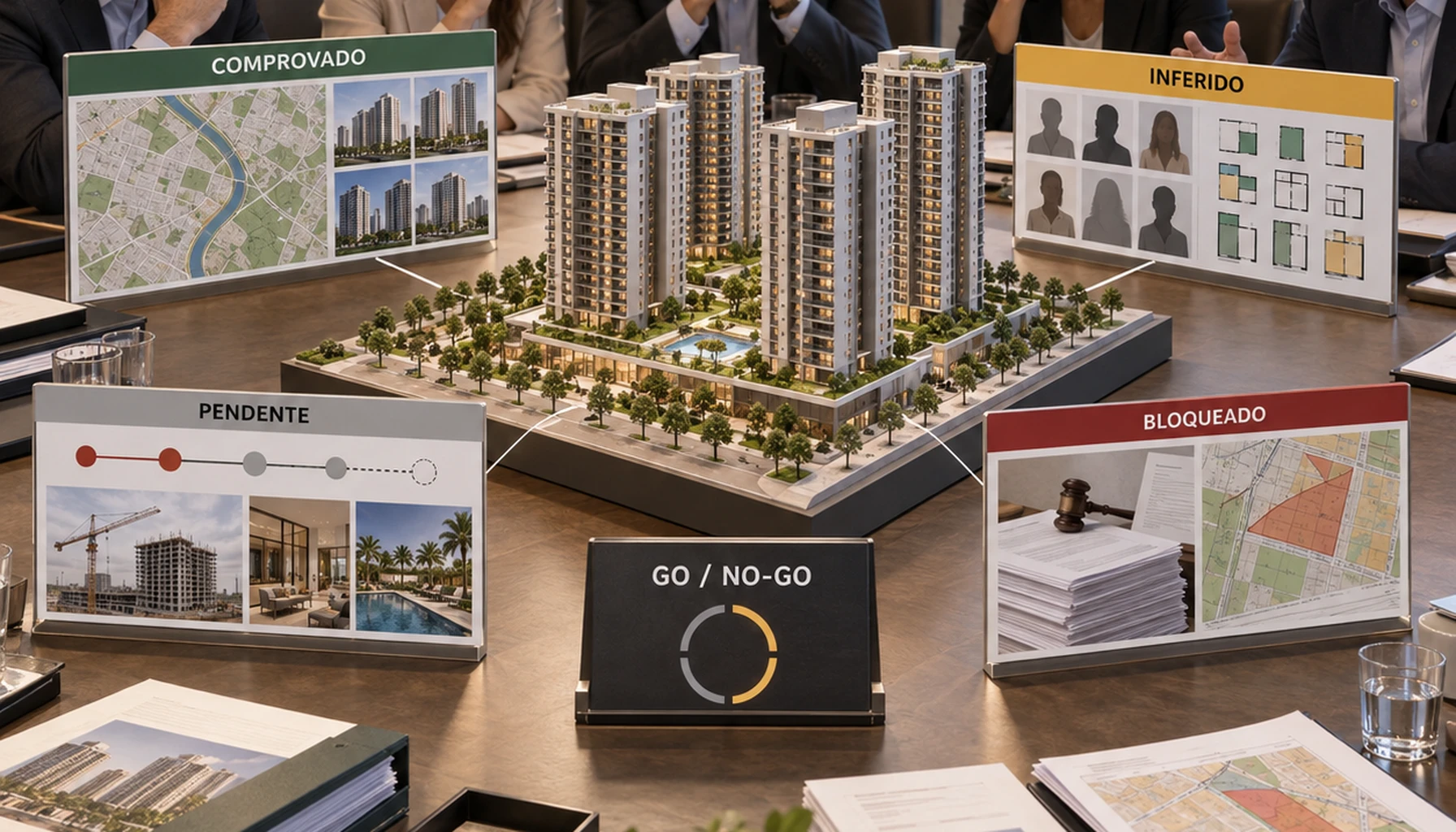
- Decision rule: Record unresolved evidence as inferred, pending or blocked. Do not disguise it as a precise forecast.
What does commercial feasibility need to prove?
Commercial feasibility must show that the proposed product can compete for a defined group of buyers in a defined local market and period. Its assumptions must be traceable and open to challenge. Launches, sales and supply are relevant categories, but the approved sources do not establish that any one is sufficient alone.
Start with the decision: land acquisition, product configuration, pricing, launch authorization or interruption. Then define the market boundary, observation dates, proposed unit types and intended buyer profile. A broader real estate feasibility study before buying land in Brazil should connect this commercial assessment to the other workstreams.
Use four evidence statuses:
- Proven: supported by a retrieved source or verified primary record, with date and scope.
- Inferred: a reasoned conclusion based on explicit assumptions.
- Pending: requested evidence that has not been verified.
- Blocked: a necessary method or input is absent, inconsistent or unsuitable.
Which market boundary and period should be used?
Use a local boundary that represents the proposed development's competitive arena and one compatible period for all comparisons. The approved sources prescribe neither boundary nor period. Selection is therefore an analytical judgment that must be documented, tested and disclosed beside any conclusion drawn from the resulting dataset.
Record why an intended buyer might regard each included location as an alternative. Record exclusions too. A citywide average may combine products with different access, unit mixes, positioning and competing supply. That is an analytical limitation, not a sourced statistical finding.
Time bases must also align. Launches, gross sales, cancellations, net sales and available supply should cover compatible periods. A current competitor price list, an older sales estimate and an annual national indicator should not be combined without clearly identifying the mismatch.
Which competitors are genuinely comparable?
A comparable development should resemble the proposal on variables that could affect buyer choice. Inclusion requires a recorded rationale; proximity alone does not prove substitutability. The approved evidence supplies no universal factor for adjusting differences in location, product, delivery stage, amenities, unit size or payment conditions.
A defensible competitive study for a property launch should record:
- location and reason for inclusion in the area of influence;
- launch date and observation date;
- development stage and expected delivery context;
- unit types, areas and relevant product attributes;
- verified available units and future competing pipeline;
- source, collection date and coverage for every field;
- material differences that weaken comparison.
Segment incompatible projects or exclude them from the main comparison. Do not hide their differences inside an average.
What do launches, sales and supply actually show?
Launches, sales and supply describe activity within the market covered by the underlying research. They become evidence about a proposed development only through a documented local and product-level comparison. National or multi-market reports can supply context and terminology, but they cannot replace evidence from the relevant competitive area.
CBIC published pages covering the second quarter of 2025 and the fourth quarter and full year of 2025. They confirm that CBIC reports launches, sales and supply for its covered Brazilian market. The retrieved records did not provide complete tables, sampling, territorial coverage, formulas or revision rules. This article therefore reproduces no record or percentage as proof of local demand.
The Brazilian Association of Real Estate Developers, known as ABRAINC, published an April 24, 2025 page about the ABRAINC-Fipe indicator for new properties. Its title contains a growth percentage. That figure is not reused because the approved research did not recover the complete base period, sample, segmentation, formula or treatment of cancellations.
How should net sales and cancellations be calculated?
CBIC's 2017 glossary defines net sales as gross sales minus cancellations. The calculation is valid only when both inputs cover the same period and use the same unit, either a count of units or monetary value. The recovered source specifies no denominator, rounding rule or missing-data treatment.
Net sales equal gross sales minus cancellations for the same period and in the same unit.
Do not impute missing observations without a separate, documented rule. Omitting cancellations can make retained demand appear higher than the formula permits, but the approved evidence supports no cancellation-rate benchmark.
The same glossary defines VGL as the sum, in current reais, of the monetary values of units launched in the analyzed period. It has no denominator. Rounding and missing-data treatment were not recovered. VGL describes launch value, not proven sales or buyer demand.
Can list price or price per square metre prove feasible pricing?
No. The approved evidence does not demonstrate that an advertised price equals a completed transaction price. A price-per-square-metre comparison remains blocked until its source, area denominator and treatment of duplicates, outliers, location, unit type and commercial incentives are documented for every material observation.
Identify whether each value is an initial list price, revised table price, incentive-adjusted amount or completed transaction. No verified FipeZAP methodology applicable to this analysis was recovered. Consequently, advertised asking prices should not become assumed project revenue.
The evidence problem is examined further in List Price Is Not Realized Price.
Talk to a specialist
Want to see this applied to your case?
Instead of finishing the article and staying in theory, send us your situation on WhatsApp. We reply with the concrete next step.
Can VSO or IVV be used as an approval benchmark?
Not with the current evidence package. VSO remains blocked because no verifiable formula or rules were recovered for initial inventory, available supply, launches, sales, cancellations and period. VSO and IVV should not be treated as interchangeable, and no benchmark should be invented or borrowed from another method.
Before calculating either indicator, select a documented definition, reproduce its formula and apply it consistently to comparable observations. The guide to VSO versus IVV explains why method and period must accompany the result.
Until those conditions are satisfied, show the metric as blocked rather than publishing an unsupported percentage.
What evidence is still needed from prospective buyers?
Primary research should test buyer, product and payment assumptions that secondary indicators cannot establish for the specific project. Local population, households, income and payment capacity remain unknown in the approved package because no direct, verifiable documents from the Brazilian Institute of Geography and Statistics or Central Bank of Brazil were recovered.
A research brief should state who was contacted, how participants were recruited, when fieldwork occurred, which product and payment terms they assessed, and where the sample is weak. Expressions of interest are not contracts or net sales. Any projected conversion remains an inference until an appropriate record supports it.
Where comparable history is scarce, disclose the gap and test scenarios. Do not assume repetition. See estimating unit absorption without assuming history will repeat.
CBIC published pages covering the second quarter of 2025 and the fourth quarter and full year of 2025.
Which assumptions must survive financial scenarios?
Financial scenarios should test price, sales curve, inflation, interest, funding, delinquency, taxes, commissions and cancellations. These are required review topics from the approved handoff, not verified forecasts or prescribed values. Each input must retain its source, date, unit, period, transformation and evidence status.
The current package supports no return, internal rate of return, net present value, margin, payback or cost-of-capital figure. A Selic rate or national average cannot determine commercial approval without an applicable series, reference date and documented connection to the intended buyers and product.
Scenarios reveal sensitivity. They do not remove uncertainty.
Why are legal and urban-planning reviews independent?
Commercial indicators cannot establish legal or urban-planning feasibility. Title, ownership, encumbrances, zoning, land use, licensing, incorporation, subdivision and contracts require independent examination. A commercially promising concept may be unable to proceed as configured, while legal permission alone says nothing about buyer demand.
Keep separate findings for the commercial, financial, legal and urban-planning workstreams. Reconcile them only at committee level, with unresolved conditions shown beside the recommendation.

What should the go/no-go committee receive?
The committee should receive a traceable evidence register, not merely a recommendation. Every material claim should identify its evidence status, source, date, scope, limitation, owner and decision consequence. This structure lets reviewers distinguish an adverse finding from a question that is answerable but still pending.
The decision pack should contain:
- the decision and alternatives under review;
- the local market boundary and compatible observation period;
- the comparable-product register and exclusions;
- verified competing supply and pipeline;
- gross sales, cancellations and net sales on compatible bases;
- primary buyer research, recruitment method and limitations;
- financial scenarios with documented inputs;
- independent legal and urban-planning findings;
- unresolved evidence and conditions for reconsideration.
Approve only when supported evidence is sufficient for the stated decision and residual uncertainty fits the committee's explicit risk tolerance. Revise when the product or assumptions need adjustment. Deepen due diligence when a material question remains answerable. Interrupt when an indispensable premise is blocked or the evidence contradicts the proposal.
Sources and limitations
The source package supports only the claims and definitions identified below. Its national market pages provide context, not proof of project-level demand. The 2017 glossary is old, and only selected definitions were recovered. Complete methodologies, samples and revision rules were unavailable for several records.
- CBIC, “Mercado imobiliário mantém estabilidade nas vendas e registra redução na oferta no 2º trimestre de 2025”. Competence: Q2 2025. Accessed September 28, 2026. Publication date, coverage, sample, formulas and comparability were not recovered.
- CBIC, “Mercado imobiliário fechou quarto trimestre de 2025 com recordes em lançamentos e vendas”. Competence: Q4 and full-year 2025. Accessed September 28, 2026. Complete figures, sample and method were not recovered.
- CBIC, “Indicadores Imobiliários Nacionais 2017”. Publication and competence: 2017. Accessed September 28, 2026. Used only for the recovered definitions of net sales and VGL; the full methodology was not recovered.
- ABRAINC, “Lançamentos de imóveis novos crescem 23,4% nos últimos 12 meses”. Published April 24, 2025. Accessed September 28, 2026. The title's percentage is not reused because the complete base period, sample and method were not recovered.
FAQ
How do I assess the commercial feasibility of a real estate development?
Assess commercial feasibility by defining the local market, comparable product and analysis period, then verifying competing supply, pipeline, launches, net sales, cancellations and buyer research. Test price and sales assumptions in financial scenarios, while keeping commercial conclusions separate from independent legal, urban-planning and financial due diligence.
How is a real estate development feasibility analysis conducted?
A real estate feasibility analysis compares traceable market evidence with the proposed product, pricing and sales plan. Record each source’s date, geography, coverage and methodology; distinguish verified facts from assumptions; test downside scenarios; document unresolved issues; and recommend approval, revision, further diligence or interruption accordingly.
When should I conduct a feasibility study for a development?
Conduct the feasibility study before acquiring land, authorizing a launch or committing significant capital, then update it whenever material assumptions change. Early analysis helps identify evidence gaps while alternatives remain open. Approval should wait when local demand, comparable supply, pricing, sales velocity or legal and planning conditions remain unverified.
What is commercial feasibility in real estate development?
Commercial feasibility determines whether a proposed development has an addressable local market, a defensible product and price position, and a plausible sales path under documented assumptions. It does not prove financial, legal or urban-planning feasibility, which require separate analyses using appropriate evidence, methods and accountable reviewers.
What evidence should a real estate feasibility study include?
A robust study should include a consistent local and time-based market definition, genuinely comparable developments, competing inventory and future pipeline, documented net sales and cancellations, and primary buyer research. It should also present testable financial assumptions, scenario results, source provenance, methodological limitations and independent legal and planning findings.
Is a detailed feasibility study worth the cost before project approval?
A detailed study is justified when its cost is weighed against the capital exposed by an unsupported approval. Its value lies in revealing weak comparables, missing demand evidence and fragile assumptions before commitments become difficult to reverse. ROI cannot be claimed without verified project costs, alternatives and avoided-loss assumptions.
What's the best way to know whether market data actually applies to my development?
Market data applies only when its geography, period, product segment, sample and definitions match the decision being evaluated. National aggregates or asking prices cannot establish demand or transaction prices for a specific project. Document coverage and methodology, reconcile multiple sources, and label unsupported extrapolations as assumptions or unknowns.
Talk to a specialist
Have a real case to solve?
Message Imovitec on WhatsApp. We reply fast and already speak your context — no forms, no waiting.
Frequently asked questions
How do I assess the commercial feasibility of a real estate development?
Assess commercial feasibility by defining the local market, comparable product and analysis period, then verifying competing supply, pipeline, launches, net sales, cancellations and buyer research. Test price and sales assumptions in financial scenarios, while keeping commercial conclusions separate from independent legal, urban-planning and financial due diligence.
How is a real estate development feasibility analysis conducted?
A real estate feasibility analysis compares traceable market evidence with the proposed product, pricing and sales plan. Record each source’s date, geography, coverage and methodology; distinguish verified facts from assumptions; test downside scenarios; document unresolved issues; and recommend approval, revision, further diligence or interruption accordingly.
When should I conduct a feasibility study for a development?
Conduct the feasibility study before acquiring land, authorizing a launch or committing significant capital, then update it whenever material assumptions change. Early analysis helps identify evidence gaps while alternatives remain open. Approval should wait when local demand, comparable supply, pricing, sales velocity or legal and planning conditions remain unverified.
What is commercial feasibility in real estate development?
Commercial feasibility determines whether a proposed development has an addressable local market, a defensible product and price position, and a plausible sales path under documented assumptions. It does not prove financial, legal or urban-planning feasibility, which require separate analyses using appropriate evidence, methods and accountable reviewers.
What evidence should a real estate feasibility study include?
A robust study should include a consistent local and time-based market definition, genuinely comparable developments, competing inventory and future pipeline, documented net sales and cancellations, and primary buyer research. It should also present testable financial assumptions, scenario results, source provenance, methodological limitations and independent legal and planning findings.
Is a detailed feasibility study worth the cost before project approval?
A detailed study is justified when its cost is weighed against the capital exposed by an unsupported approval. Its value lies in revealing weak comparables, missing demand evidence and fragile assumptions before commitments become difficult to reverse. ROI cannot be claimed without verified project costs, alternatives and avoided-loss assumptions.
What's the best way to know whether market data actually applies to my development?
Market data applies only when its geography, period, product segment, sample and definitions match the decision being evaluated. National aggregates or asking prices cannot establish demand or transaction prices for a specific project. Document coverage and methodology, reconcile multiple sources, and label unsupported extrapolations as assumptions or unknowns.
Imovitec
Turn data into next steps.
Take the Imovitec diagnostic and see where your best opportunities are.